"What is my home worth?" Before selling, almost every owner already has three numbers in mind. One from an online estimator, one from the municipal tax bill, and the asking price of a similar house down the street.
Those numbers almost never agree. That is normal: each one answers a different question, at a different date. Here are the three common ways to estimate the value of your home, how to read each one, and which to use to set a sale price.
The short version
- For a home that is not for sale, the median error of online estimators ranges from 7% to 20%, according to published data.
- The 2026-2028 municipal assessment describes the market of July 1, 2024, not today's.
- Only a broker's comparative market analysis starts from recent sales in your area, adjusted for your home's actual condition.
- A chartered appraiser remains the reference when an impartial opinion is needed: financing, an estate, a separation.
Why do three estimates give three different numbers?
Because they do not measure the same thing. An online estimator applies a formula to public data. The municipal assessment freezes value at a past reference date. A comparative market analysis looks for the price a buyer would pay for your home, now.
| Method | What it measures | Visits the home? | Use it for |
|---|---|---|---|
| Online estimator | An average calculated from public data | No | A first idea, nothing more |
| Municipal assessment | Value as of July 1, 2024, for taxation | Rarely | Calculating your property taxes |
| Broker's comparative analysis | The likely price today, based on recent sales | Yes | Setting a sale price |
| Chartered appraiser | An impartial, reasoned opinion of value | Yes | Financing, estates, disputes |
The online estimator: fast, but it never visits
Even the best-known estimator gets it wrong. In 2026, Zillow reports a median error of 7.20% for US homes that are not for sale, compared with 1.79% for homes that are listed (Zillow, What is a Zestimate?).
The gap is easy to explain. Once a home is listed, the algorithm knows its asking price and uses it. When it is not, which is your situation before selling, it guesses from tax records and past sales.
In Canada, the numbers are worse. A Toronto broker tracked 95 sales in 2021: the median error was 11.7% for HouseSigma, 13.4% for Zoocasa and 20.2% for Zolo, and HouseSigma came in too low 85% of the time (Storeys, December 17, 2021). It is a small sample, but it gives the order of magnitude.
Applied to the median single-family price in the Montreal area, $650,000 in August 2026, an 11.7% error is about $76,000. That is more than the negotiating margin of a normal sale.
An estimator does not know that your kitchen was redone, that the basement leaks, or that your street faces a park rather than a highway. It is useful for a first idea. It is not useful for setting a price.
The municipal assessment: a snapshot of July 2024
The 2026-2027-2028 assessment rolls for the Montreal agglomeration were filed on September 10, 2025, with a reference date of July 1, 2024 (City of Montreal, property assessment rolls). The value of buildings with five units or fewer rose by 9.6% on average.
The City says so itself: the value on the roll is the most probable price under market conditions as they existed 18 months before the roll took effect. That figure will be used until the end of 2028, more than four years after its reference date.
The market has moved since July 2024. In August 2026, the Montreal area had 18% more homes for sale than a year earlier, and a condo took 62 days to sell, 12 more than in 2025 (QPAREB, Centris statistics for August 2026). A figure frozen in 2024 cannot reflect that.
The municipal assessment is still useful for one thing: calculating your taxes. To understand in detail why it drifts from the sale price, in either direction, read my article on municipal assessment vs sale price in Montreal.
The comparative market analysis: the one that sells
The OACIQ asks brokers to help sellers establish fair market value, supported by objective elements, available comparables, and the property's features, condition and market context (OACIQ, Verification, information and advice guideline, section 4). That is exactly what a comparative market analysis does.
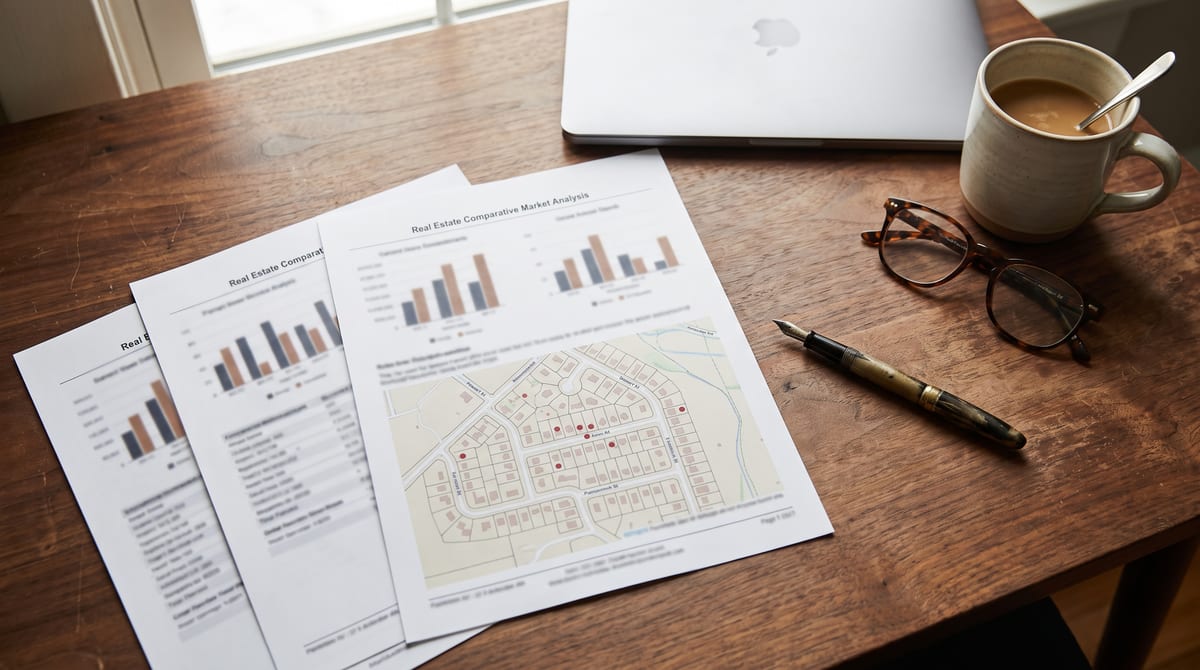
In practice, here is how I build one for a seller:
- Completed sales, not asking prices. An asking price proves nothing until someone accepts it. I start from properties actually sold in the last three to six months.
- A tight radius. Same property type, same area, often a few streets. A Rosemont plex does not compare to a Verdun plex.
- Visible adjustments. Renovations, parking, floor, orientation, roof condition. Every difference with a comparable becomes a priced, explained adjustment.
- A visit. That is what no algorithm does. A home's actual condition can move its value by tens of thousands of dollars.
- The market context. A slowing segment is not priced like one where buyers compete.
An example, to see how it works. The figures below are fictional and only illustrate the method: in a real analysis, each adjustment is measured against sales in the area.
| Comparable: semi-detached sold three months ago, same street | Adjustment |
|---|---|
| Comparable's sale price | $700,000 |
| Your home has parking, the comparable does not | + $15,000 |
| The comparable has a renovated kitchen, yours is original | − $25,000 |
| Your roof needs replacing within two years | − $12,000 |
| Value indicated by this comparable | $678,000 |
The exercise is repeated with three to six comparables. The indicated values cluster around a zone, and that zone, not a single number, gives the price range.
From that range, I present three pricing positions to the seller with the pros and cons of each, as I explain in my article on optimizing your sale price.
Want to see this analysis for your own home? Request your free evaluation, with no commitment.
And a chartered appraiser, when?
A chartered appraiser is a member of the Ordre des évaluateurs agréés du Québec. Their report is a reasoned, reliable and impartial opinion of value, built through a four-step process: mandate, research, analysis and estimate (OEAQ, Why a chartered appraiser).
It is the right tool when a third party must rely on the value: a lender, an estate to divide, a separation, a dispute. To set a sale price, a comparative analysis from a broker active in your area is usually enough, and it costs the seller nothing.
What the 2026 market changes about your estimate
In August 2026, the median price reached $650,000 for a single-family home (+3% year over year), $437,250 for a condo (+4%) and $856,000 for a plex (+2%) in the Montreal area (QPAREB data reported by CP24, September 4, 2026).
Prices are still rising, but more slowly, and supply is growing. QPAREB notes that single-family homes still favour sellers in most areas, while condos on the island of Montreal sit at the edge between a balanced market and a buyer's market.
In other words, the same method does not give the same result everywhere. A house in Villeray and a downtown condo are not priced the same way, even if both owners saw their municipal assessment go up.
Mistakes that skew an owner's estimate
- Trusting the neighbour's asking price. It is a wish, not a sale. Many homes sell below asking, or do not sell at all.
- Adding up renovation costs. A $60,000 kitchen does not add $60,000 in value. Buyers pay for what they see, not for what you spent.
- Starting from the purchase price plus inflation. Your area's market may have moved much faster, or much slower.
- Applying the roll's average increase. The 9.6% average covers the whole agglomeration. Your street may be well above or well below it.
Overpricing is expensive. A home listed too high loses its first, most active weeks and often ends up selling for less, as I explain in my article on selling your house fast in Montreal.
Getting a home value estimate in Montreal you can rely on
An online estimator gives you an idea. The municipal assessment gives you your tax bill. To know what your house is worth in today's market, you need to start from recent sales in your area and your home's actual condition.
What to gather before your evaluation
That is what I do with every seller, free of charge and with no commitment. Request your free home evaluation: I visit the property, show you the comparable sales in your area and an explained price range, and you then decide whether and when to sell. You can also write to me directly.
In short: what your house is worth, in four points
- An online estimator gives a first idea, with a median error of 7% to 20% for a home that is not for sale.
- The municipal assessment is for your taxes: it describes the market as of July 1, 2024.
- To sell, only a comparative market analysis starts from recent sales in your area and the home's actual condition.
- A chartered appraiser is the right call when a third party must rely on the value: a lender, an estate, a separation.
Sources consulted on September 30, 2026: Zillow, What is a Zestimate? (US data); Storeys, December 17, 2021; City of Montreal, September 10, 2025 release on the filing of the 2026-2027-2028 assessment rolls; QPAREB, Centris residential sales statistics for August 2026, Montreal CMA, and CP24, September 4, 2026; OACIQ, Verification, information and advice guideline (section 4); OEAQ. This article is for information only and does not replace an evaluation of your property.